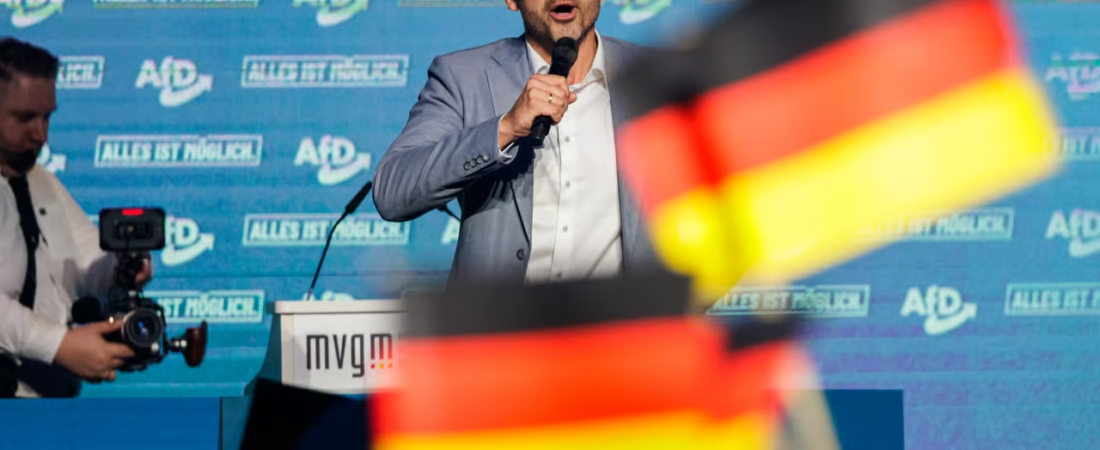
In an unprecedented shift in Germany’s post-war political landscape, the far-right Alternative for Germany (AfD) has secured a commanding victory in the eastern state of Saxony-Anhalt. Winning approximately 44 percent of the vote on high turnout, the party has moved to the brink of state-level governance for the first time in its history.
The outcome represents a historic blow to Chancellor Friedrich Merz’s Christian Democratic Union (CDU), which saw its regional vote share collapse from over 37 percent in 2021 to below 18 percent. The Christian Democrats had governed Saxony-Anhalt for over two decades, but voter dissatisfaction with the federal coalition and soaring cost-of-living pressures triggered a major realignment in favor of the nationalist opposition.
The Coalition Arithmetic
With 39 seats in the state legislature, the AfD sits just three seats short of an absolute majority of 42. Party co-leader Alice Weidel described the outcome as a definitive mandate to govern, signaling openness to coalition discussions. However, the path to installing AfD candidate Ulrich Siegmund as state premier remains complex:
- Alliance with BSW: The populist left-wing Bündnis Sahra Wagenknecht (BSW), which rejects the traditional political “firewall” against the far right, holds enough seats to form a working majority, though formal power-sharing talks face hurdles over leadership models.
- Individual Defections: AfD leadership has indicated it is prepared to recruit individual lawmakers from conservative benches to cross the floor and establish a functional majority.
- Grand Coalitions of Exclusion: Mainstream parties could attempt to construct a fragile multi-party minority alliance, though AfD leaders warn such maneuvers would only amplify voter resentment in upcoming federal and state contests.
Economic Anxiety and Eastern Discontent
Saxony-Anhalt remains Germany’s lowest-earning federal state, leaving its electorate uniquely sensitive to industrial stagnation, high energy prices, and structural decline. Exit polls indicated that nearly three-quarters of voters expressed severe anxiety regarding inflation and the preservation of living standards.
Campaigning on hardline immigration curbs, family subsidies, cultural conservatism, and the restoration of close economic and diplomatic ties with Moscow, the AfD capitalized on deep-seated alienation from Berlin’s political establishment. The party’s triumph in Saxony-Anhalt significantly surpasses its earlier 32.8 percent result in Thuringia, confirming its position as the dominant political force across eastern Germany.
Analysis: Implications for EU Enlargement and Bloc Strategy
The AfD’s historic surge sends shockwaves well beyond Magdeburg and Berlin, presenting direct strategic challenges for the European Union’s broader geopolitical agenda:
- Paralysis of German Leadership: As the EU’s largest economy and key net contributor, a domestically embattled German government under pressure from populist surges may find its ability to drive consensus in Brussels severely constrained. Domestic instability often prompts member state leaders to adopt risk-averse stances in European Council negotiations.
- Headwinds for EU Enlargement: The momentum behind pro-Russian, Eurosceptic factions complicates the EU accession pipeline for Ukraine, Moldova, and the Western Balkans. A politically weakened Berlin will face intense domestic resistance to the budgetary increases and treaty reforms necessary to absorb new member states.
- Fractured European Unity on Foreign Policy: The AfD’s explicit platform favoring rapprochement with Moscow undermines the bloc’s sanctions regime and military support frameworks for Kyiv, encouraging other nationalist factions across Central and Eastern Europe to challenge European foreign policy cohesion.
As further regional elections approach in Mecklenburg-Western Pomerania and Berlin, the seismic result in Saxony-Anhalt confirms that Germany’s political fragmentation will remain a defining variable in European governance for years to come.
Based on reporting from POLITICO.